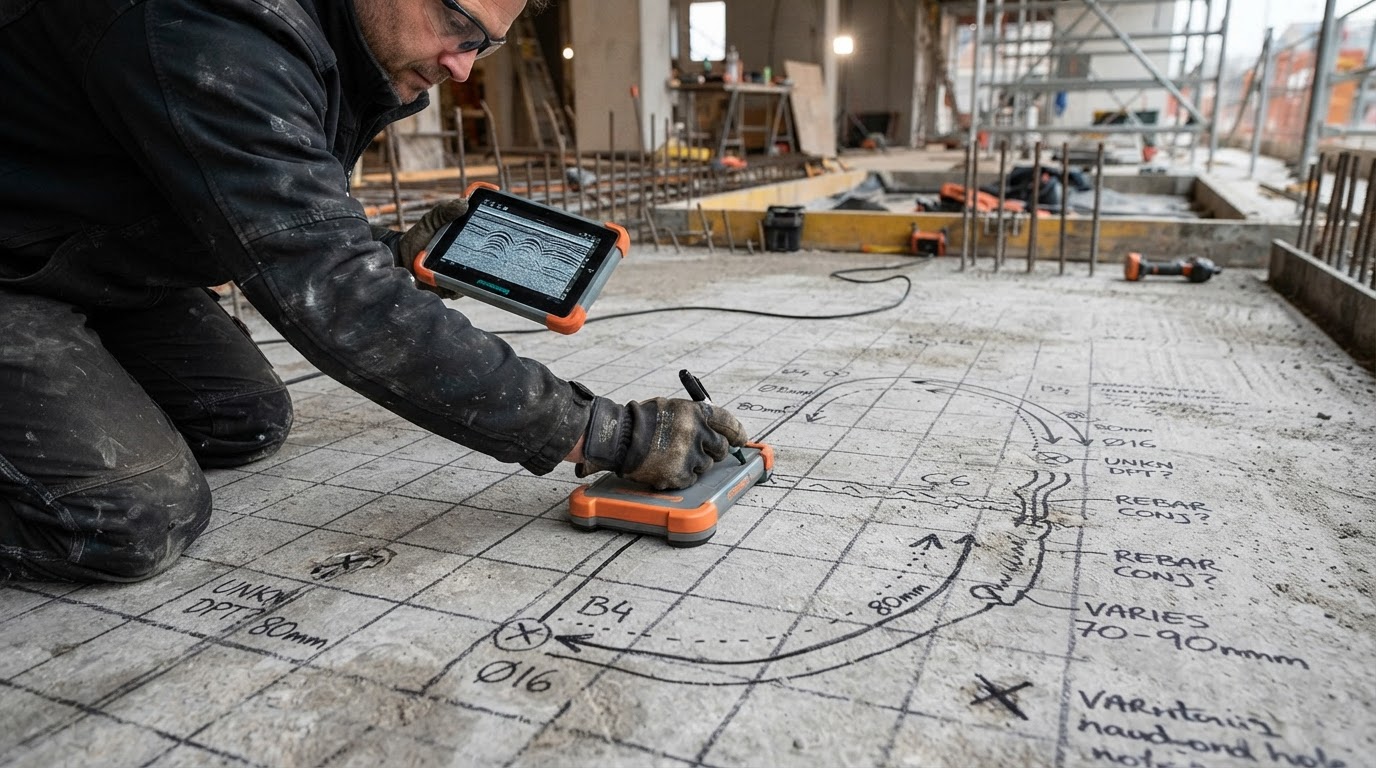
Give the scan a specific question
A useful scan begins with an approved proposed hole, line or zone and a clear target: reinforcing, post-tensioning, conduits or another embedded concern. Scanning an undefined area without knowing the decision it must support can produce information that is difficult to apply.
Provide the expected slab or wall build-up, accessible faces, drawings and known service routes. State whether the deliverable should be surface marks, photographs, a grid record or a written report.
How GPR contributes to the review
Ground-penetrating radar sends electromagnetic energy into the material and records responses from changes within it. An experienced operator interprets patterns that may be consistent with reinforcing, tendons, voids or services.
The result is not a photograph of the concrete. Depth, moisture, aggregate, surface condition, target orientation and congested reinforcement can affect interpretation.
- Direct access to a suitable surface
- Grid or survey coverage appropriate to the target
- Equipment settings and calibration suited to the material
- Experienced interpretation
- Clear marking and explanation of uncertainty
Combine scanning with other evidence
Shallow reinforcement can mask deeper targets, closely spaced objects can merge, and different materials can produce similar responses. Some services may be difficult to distinguish without complementary locating methods or drawings.
Use the scan with as-constructed information, service isolation, visual checks and structural advice. If an area is inaccessible or inconclusive, record that limitation rather than converting uncertainty into an all-clear.
Keep a hold point before the cut
After the surface is marked, the responsible party should review whether the proposed position remains acceptable. A relocated hole can affect pipe fall, equipment clearance, edge distance, fire separation or structural design.
Only proceed after the final location, diameter or cut line is approved. Where scanning and cutting are supplied together, this decision should still be explicit.
- Scan completed and marked
- Uncertainty and inaccessible areas recorded
- Revised position checked against the design
- Relevant services isolated
- Final approval recorded before drilling or sawing
Scanning guide questions
Does GPR find every embedded service?
No. Conditions and target properties affect detection and interpretation. Use multiple evidence sources and retain uncertainty where it exists.
Can scanning determine whether reinforcing may be cut?
It may help locate reinforcing, but permission to cut structural steel is a design decision for the responsible engineer or authority.
Is a report always included?
No. Agree the deliverable before attendance. Surface marking alone may not meet a project's documentation needs.
Should the scan cover only the exact hole centre?
The operator may need a broader grid to understand surrounding patterns and provide a useful alternative position. Define the available zone.