Service · Road & floor sawing
Road and Floor Sawing in Penrith
For a trench, joint, driveway cut or slab section, confirm the line length, depth, material, access and what happens between or beyond the cuts.
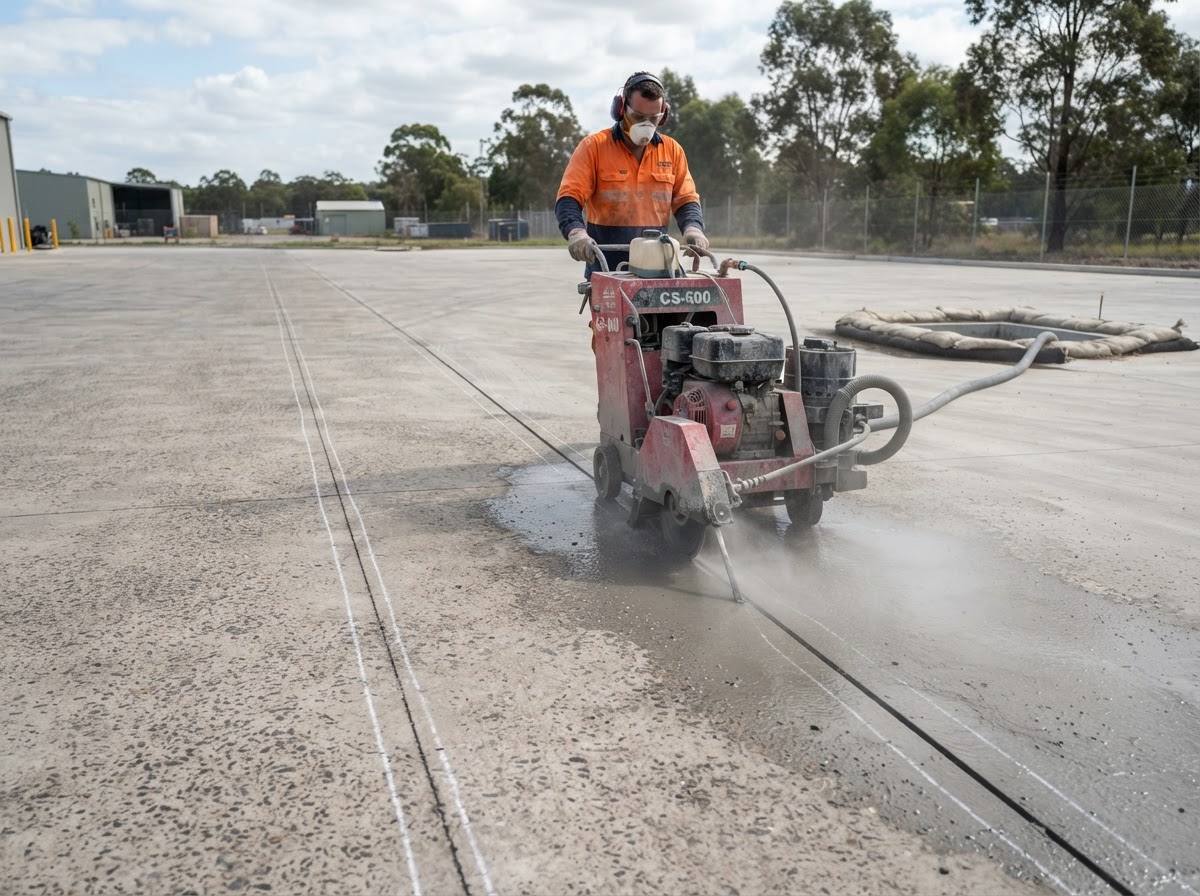
Straight cuts across horizontal surfaces
Road, floor and slab saws are designed to travel along a horizontal surface. They are considered for cuts through concrete floors, driveways, pavements, asphalt, hardstands and similar areas where a straight line and controlled depth are required.
Common jobs include service trenches, isolation or expansion joints, cutting around a section to be removed, trimming damaged pavement and separating a slab before demolition or repair.
- Single cut lines across a slab or driveway
- Parallel cuts for a plumbing, drainage or conduit trench
- Perimeter cuts around a panel or damaged section
- Joints specified in existing or newly completed work
- Cuts through pavement or hardstand subject to access and permits
Depth, travel path and edge clearance set the equipment choice
The provider needs enough level, stable space for the saw to travel and turn. Walls, steps, columns, kerbs, steep grades or narrow access can prevent a large floor saw from reaching the last section of a line.
Give the required depth rather than only the slab thickness. Reinforcement, layers of asphalt over concrete, unknown services and the need for multiple passes can change the sequence. Hand or ring sawing may be needed near edges.
- Total length and number of lines
- Specified cut depth and material layers
- Clear width for the saw and equipment access
- Distance from walls, corners and obstructions
- Reinforcement, embedded services and scan information
A service trench is more than two cut lines
A trench brief should state who sets out the route, confirms services, breaks out the centre strip, excavates below the slab, installs the service and reinstates the surface. These are separate tasks and should not be assumed from the words 'cut a trench'.
The centre strip may be heavy or difficult to remove in one piece. Segment size, lifting or breakup, spoil access and protection of nearby finishes need to be considered before the work is priced.
External and active-site controls
Road or hardstand work can affect vehicles, pedestrians, drainage and neighbouring operations. Permits, traffic control, public-space approvals and restricted work windows may sit outside the cutting provider's scope unless clearly included.
Wet cutting produces slurry that must be contained and recovered rather than allowed to enter stormwater. Confirm water access, cleanup, surface protection and whether the area must reopen to traffic at a particular time.
- Vehicle and pedestrian separation
- Permits and traffic-control arrangements
- Stormwater and slurry containment
- Operating-site or after-hours access
- Temporary covers, barriers and reopening requirements
What affects a road or floor-sawing quote
| Job or scenario | What affects cost | What the quote should clarify |
|---|---|---|
| Straight cut across a driveway or ground slab | Length, depth, reinforcement, access for the saw, drainage and whether the strip is removed | Minimum attendance, cut depth, slurry control, removal, disposal and reinstatement by others |
| Trench cuts for plumbing, drainage or conduit | Two cut lines, spacing, slab thickness, services, excavation depth and handling of the centre strip | Set-out, scanning, concrete breakout, excavation, spoil, service installation and making good |
| Expansion or isolation joints | Joint layout, timing, specified depth, slab condition and total lineal length | Design responsibility, line marking, depth tolerance, sealing and cleaning |
| Road, pavement, kerb or external hardstand work | Traffic and pedestrian control, permits, asphalt or concrete layers, access windows and water management | Traffic-control responsibility, permits, disposal, reinstatement and after-hours conditions |
| Deep or reinforced floor cut | Saw capacity, reinforcement, multiple passes, edge clearance and slab support | Maximum confirmed depth, cutting sequence, scan requirements and alternative methods if access is limited |
The evidence supports a cost-driver guide, not a universal per-metre price. Scope must distinguish cutting from scanning, breakout, excavation, removal, traffic control and reinstatement.
Road and floor sawing questions
Can a floor saw cut right against a wall?
A large blade and machine need clearance. The final section near a wall or corner may require a different saw or a planned allowance.
Does trench cutting include breaking out the concrete?
Only when the scope says so. Confirm cutting, breakout, excavation, concrete removal, disposal, service installation and reinstatement separately.
Can you cut through asphalt and concrete?
Different layers can be cut, but the provider needs the material build-up and target depth. Tooling, slurry and disposal may differ between asphalt and reinforced concrete.
Who arranges traffic control?
The responsible party depends on the site and quote. Public or operational areas may require permits and a qualified traffic-control plan before cutting starts.