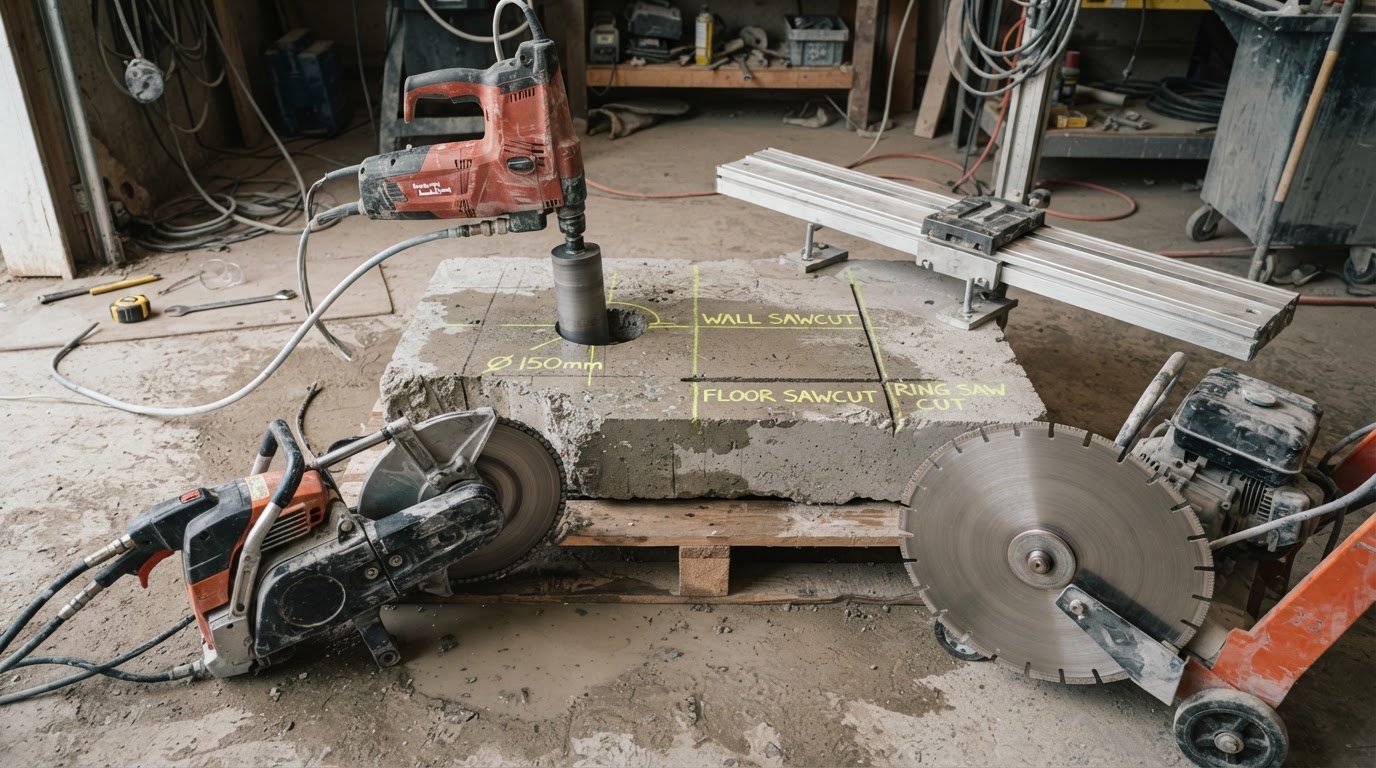
1. Start with the shape you need
A circular penetration points towards core drilling. A long straight line through a floor points towards road or floor sawing. A rectangular wall opening may use wall sawing, corner drilling and planned segment removal. An oversized or unusually deep section may require wire sawing.
Describe the finished opening rather than asking for a machine by name. A provider can then test whether the proposed method fits the structure, access and controls.
- Round hole: core drilling
- Straight horizontal line: road or floor sawing
- Straight wall opening: wall sawing
- Short or restricted cut: hand or ring sawing
- Very deep, large or unusual section: wire sawing
- Control joint in young concrete: early-entry or soff cutting
2. Check orientation and equipment access
The same depth can be straightforward on an open ground slab and difficult overhead, beside a wall or behind a narrow gate. Large saws need travel or mounting space; portable equipment needs a safe operator position; wire systems need room for the drive and pulleys.
Show the full access route, both faces of a wall where possible, rooms below a slab and any fixed obstacles. Method selection should include water, power, ventilation and slurry recovery.
3 · Comparison table
Compare the main methods
| Method | Best starting point | Questions that can change the choice |
|---|---|---|
| Core drilling | Round penetrations and sample cores | Diameter, depth, orientation, mounting, services, core support and slurry |
| Wall sawing | Straight openings through vertical or inclined concrete | Track access, structure, thickness, corner detail, support and panel removal |
| Road or floor sawing | Horizontal slabs, pavements, driveways and trenches | Travel path, depth, edge clearance, traffic, breakout and reinstatement |
| Hand or ring sawing | Short, detailed, edge-adjacent or restricted-access cuts | Operator clearance, power, ventilation, depth, overcut and handling |
| Wire sawing | Deep, oversized, reinforced or unusual sections | Wire path, rigging, support, lifting, water and exclusion |
| Soff cutting | Specified joints in newly placed slabs | Joint design, pour timing, depth, call-off and slab access |
This comparison is a planning guide. The final method must be confirmed against the site, structure and approved set-out.
4. Treat reinforcement and services as a separate decision
The visible surface does not show reinforcement, post-tensioning, electrical conduit, plumbing or other embedded items. Review drawings and known service information, isolate relevant services and use appropriate scanning or locating where it adds evidence.
Scanning is not a universal all-clear. Depth, congestion, material and interpretation can limit the result, so keep an approval hold point before cutting.
5. Decide what happens to the concrete
A cut releases an edge; it does not automatically move the concrete. A panel, strip or core may need support, lifting, breakdown, carrying and disposal. Large pieces can dictate the cutting sequence and equipment.
Ask the quote to separate cutting from scanning, support, lifting, breakup, loading, disposal and reinstatement. That keeps the method comparison meaningful.
Method-selection questions
Can more than one saw be used on the same opening?
Yes. For example, a wall saw may handle long straight cuts while a hand or ring saw finishes near obstructions. The combined sequence should be agreed before pricing.
Is the deepest-capable machine always best?
No. Accuracy, access, set-up, water, structure, segment handling and total site impact can make another method more suitable.
Can the choice be confirmed from photos?
Photos can help screen access and geometry, but they may not reveal thickness, reinforcement, services or structural role. Site assessment and approved information may still be required.