Service · Wire sawing
Wire Sawing in Penrith
When a concrete section is too deep, large or awkward for a conventional circular blade, diamond wire sawing may provide a controlled cutting path.
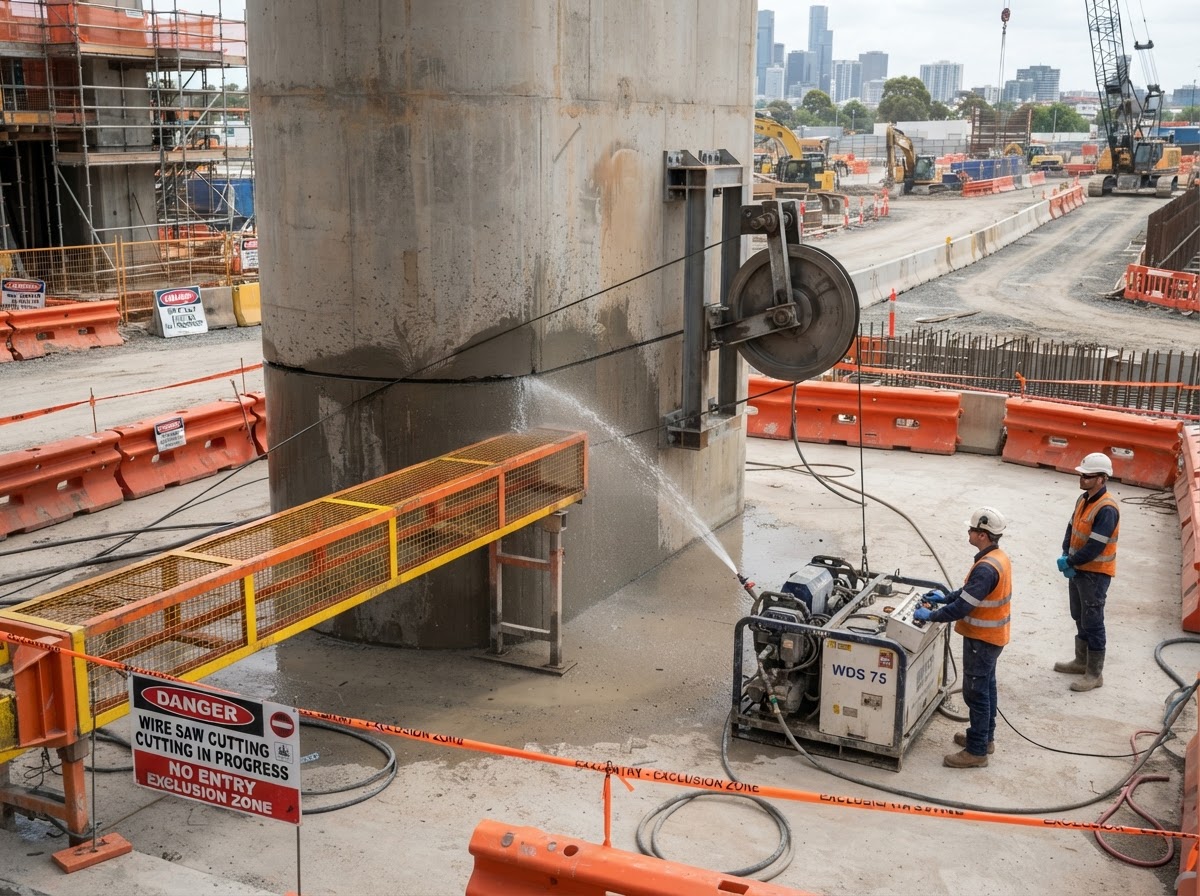
A flexible cutting path for demanding sections
Wire sawing uses a diamond-beaded wire driven around the concrete through a planned pulley arrangement. Because the cutting element is flexible, the system can be considered for deep sections, large dimensions, heavy reinforcement and geometries that exceed ordinary blade reach.
It is not a default substitute for every wall or floor cut. Set-up, access around the section, wire routing, water, guarding, support and the handling of the released concrete must justify the method.
- Deep walls, slabs or foundations
- Large columns, beams or structural elements subject to approval
- Heavily reinforced sections
- Circular, irregular or otherwise difficult geometry
- Cuts where equipment position is separated from the immediate cut face
Engineering and sequence come first
Large concrete sections can carry significant loads and release substantial weight. The responsible engineer or competent designer may need to specify temporary support, cut order, lifting points and permissible segment size.
The provider needs the approved cut line and a clear hold-point process. A change in reinforcement, access or support conditions can alter the sequence and should be escalated rather than improvised.
- Structural purpose and approved alteration
- Temporary support or propping
- Wire access holes and pulley locations
- Cut order and stop points
- Monitoring, exclusion and communication during the cut
Allow space for the drive, pulleys and water control
The wire must travel through and around the section without exposing people or adjacent property to the moving system. The drive unit, pulleys, guards and hoses need secure positions and an exclusion area.
Water cools the wire and helps control dust. Plan how it reaches the cutting zone, where slurry will flow and how it will be recovered. Sensitive plant, electrical areas, stormwater and lower levels may need additional containment.
- Access to one or more faces of the section
- Secure positions for drive and pulley equipment
- Water supply and slurry recovery
- Remote operating position and guarded exclusion
- Protection of adjacent structures and finishes
Cutting and lifting are one coordinated plan
A completed wire cut may release a section that cannot be moved manually. Crane access, lifting frames, engineered anchors, forklifts or other handling methods may be required, subject to the site.
Confirm whether lifting and transport are part of the cutting provider's scope or arranged by others. The quote should identify the interface so the cut is not completed before a safe removal route is ready.
What affects a wire-sawing quote
| Job or scenario | What affects cost | What the quote should clarify |
|---|---|---|
| Deep or oversized concrete section | Section dimensions, reinforcement, access around the cut, wire path, power and cooling | Method feasibility, cutting sequence, set-up, water/slurry control and included depth |
| Column, beam or heavily reinforced member | Structural role, temporary support, steel density, permitted cut line and segment weight | Engineering approval, support design, lifting points, hold points and removal |
| Confined or unusual geometry | Space for pulleys and drive unit, wrap angle, access to both sides and protection of adjacent surfaces | Rigging layout, penetrations for the wire, exclusions, monitoring and alternate method |
| Underwater or continuously wet application | Site-specific equipment, visibility, access, environmental controls and specialist requirements | Whether the provider offers the application, permits, containment, recovery and safety planning |
| Wire sawing combined with lifting or demolition | Segment size, crane or mechanical handling, floor capacity, access route and disposal | Who supplies lifting, engineered anchors, rigging, transport and waste charges |
Wire sawing is a specialist, engineered scope. No generic rate is stated because set-up, geometry, reinforcement, support and handling dominate the work.
Wire sawing questions
Why use wire sawing instead of a wall saw?
Wire sawing may suit greater depth, unusual geometry or very large reinforced sections. A wall saw can be more efficient for conventional straight openings when track access and blade reach are suitable.
Does wire sawing create dust?
Water is commonly used for cooling and dust suppression, so slurry management remains important. The full control plan depends on the site.
Can wire sawing be priced from dimensions alone?
No. Access for the wire and pulleys, structural support, reinforcement, water, set-up and segment handling can matter as much as the cut size.
Who designs the lifting plan?
That responsibility must be agreed for the project. Large or structural sections can require competent engineering, lifting design and qualified rigging arrangements.