Service · Core drilling
Core Drilling in Penrith
For a clean circular opening through a slab, wall or masonry surface, start with the diameter, depth, position and what may be embedded in the material.
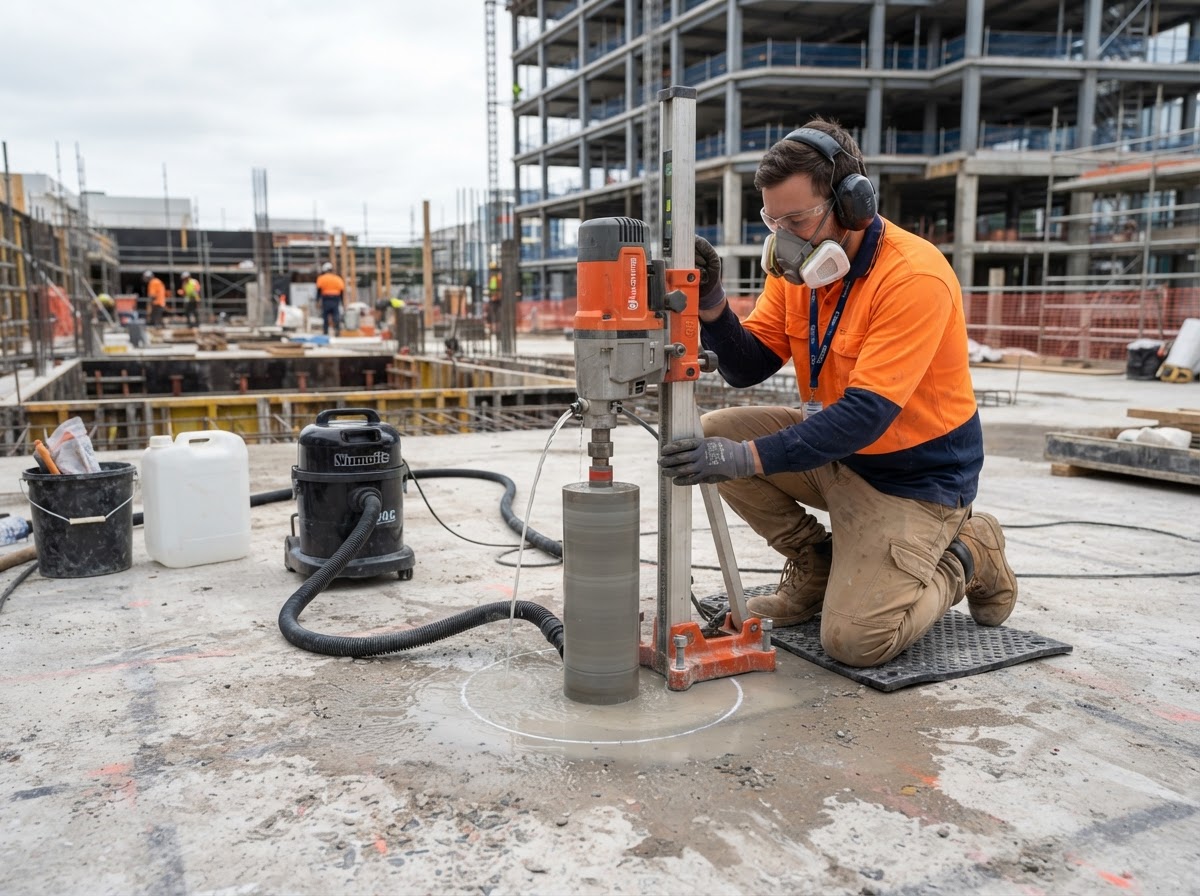
When a round penetration is the right starting point
Diamond core drilling forms a circular opening without the repeated impact of a hammer-drilled perimeter. It is commonly considered for plumbing and drainage pipework, electrical or communications conduits, ventilation, anchors, test samples and other accurately positioned penetrations.
The method can be used on horizontal, vertical or overhead surfaces when the equipment, mounting, access and containment plan suit the site. A provider still needs to check the material, reinforcement, depth and structural context before confirming the approach.
- Pipe, conduit and cable penetrations
- Ventilation and mechanical-service openings
- Anchor, balustrade or equipment penetrations where the design calls for a round hole
- Sample cores where an authorised test plan specifies the location and size
- Pilot holes that form part of an approved larger cutting sequence
Set-out, access and support matter as much as diameter
Give the proposed hole diameter and the approximate thickness of the slab or wall. Also explain how the drill can reach the surface, whether both sides are accessible and what sits below or behind the proposed opening.
Rig-mounted work may require a suitable fixing or vacuum base. Overhead or inverted work needs a deliberate water-capture and access plan. A heavy core may need support before it breaks free, especially above an occupied or finished area.
- Exact centre point and permitted tolerance
- Surface orientation and approximate thickness
- Access for the drill, operator, water and extraction equipment
- Protection of finishes, rooms or equipment below the penetration
- Who is responsible for retaining, lowering or disposing of the core
Check structure and embedded services before drilling
A marked circle does not prove the position is clear. Drawings, as-constructed information, service isolation, scanning and competent structural advice may all be relevant, particularly for suspended slabs, heavily reinforced members or post-tensioned concrete.
Concrete scanning can help interpret reinforcing and some embedded services, but the result is affected by depth, congestion, material and surface conditions. The scan should be treated as one input to the approval process, not a guarantee.
Plan the water, slurry and final opening
Water is often used to cool the diamond bit and suppress dust. The work area therefore needs a way to contain and collect slurry so it does not reach drains, electrical equipment, finished rooms or public paths.
Ask what finish is expected at the opening, whether the core should be retained, and whether sealing, fire stopping, pipe installation or making good will be handled by another trade. Those follow-on works are not automatically part of drilling.
- Water source and collection method
- Wet vacuum, bunding or protection below
- Expected edge finish and acceptable breakout
- Core retention, labelling or disposal
- Responsibility for sealing and service installation
What affects a core-drilling quote
| Job or scenario | What affects cost | What the quote should clarify |
|---|---|---|
| One or a small number of service penetrations | Diameter, depth, material, reinforcement, mobilisation and whether the position is already approved | Minimum attendance, included set-up, water and slurry control, core handling, GST and any scanning |
| A repeated group of similar holes | Quantity, spacing, access sequence, consistent depth and whether rig mounting is practical | Per-hole versus attendance components, set-out responsibility, penetrations included and changes for obstructions |
| A large-diameter or deep core | Bit size, concrete depth, reinforcement, extension requirements, cooling water and core weight | Equipment and mounting method, support below, core extraction, lifting and disposal |
| Overhead, inverted or restricted-access coring | Working position, fall risk, water capture, access equipment, occupied areas and safe mounting | Access equipment, containment, exclusion area, reinstatement responsibility and working-hour limits |
| A hole in a structural or service-congested element | Drawings, engineering approval, post-tensioning, reinforcing density, live services and scan limitations | Who approves the position, what scanning is included, isolations, hold points and consequences of a changed location |
No dollar amount is stated because the available evidence does not support a comparable Penrith rate by diameter, depth, access and inclusions. The provider confirms the complete scope and price.
Core drilling questions
Can core drilling go through reinforced concrete?
It may be possible, but reinforcement changes the cutting load and may affect whether the proposed position can be approved. Drawings, scanning and structural advice can be required.
How do I choose the hole diameter?
Use the service or fitting specification, including any sleeve, fall, fire-stopping or clearance requirement. The provider should not guess a design diameter on behalf of the relevant trade or engineer.
Will there be water?
Wet coring commonly uses water for cooling and dust control. Confirm how water and slurry will be contained, particularly indoors, overhead or above finished areas.
Can the provider drill from one side only?
Sometimes, but depth, access, breakthrough risk and the finish required on the far face can change the method. Explain whether both faces are accessible.