Service · Hand & ring sawing
Hand and Ring Sawing in Penrith
Portable saws can solve short, detailed or restricted-access cuts, but the safe method still depends on depth, clearance, reinforcement and the work environment.
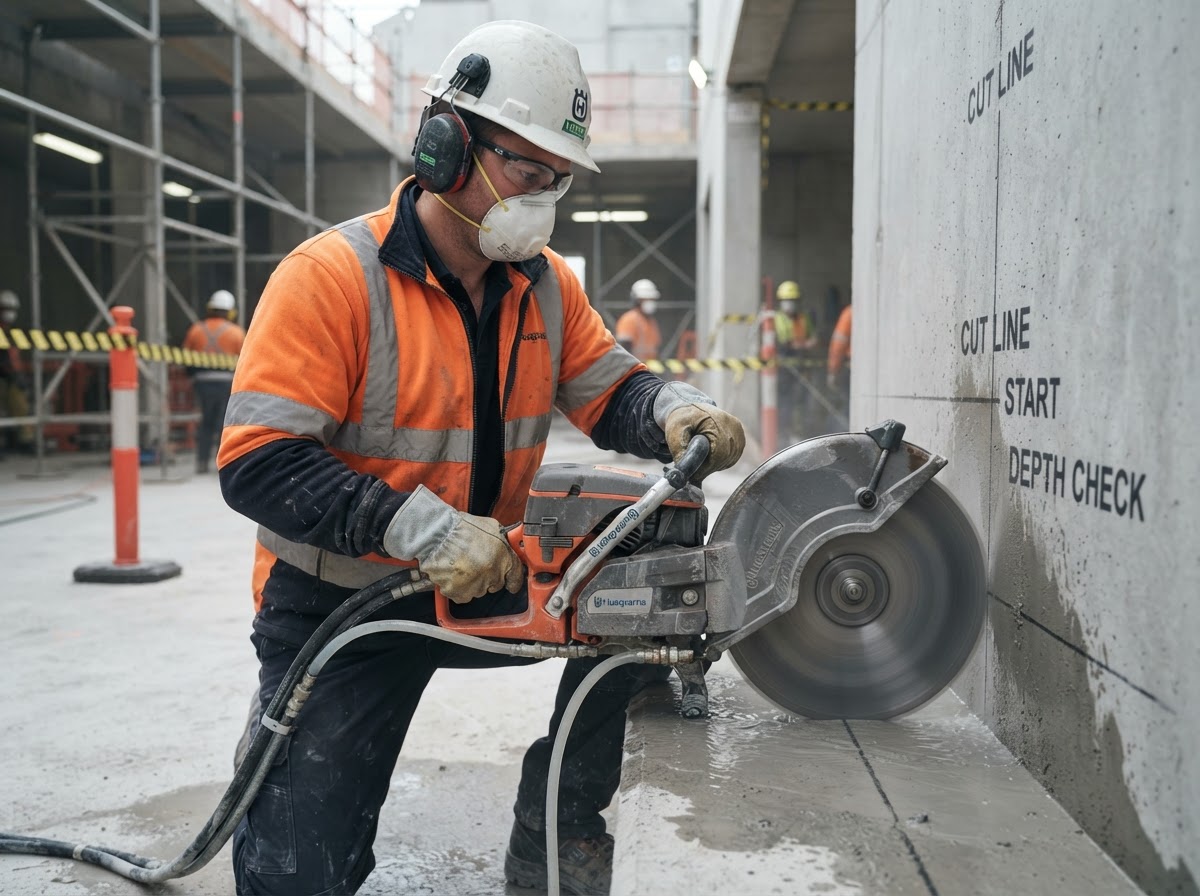
Portable equipment for detailed and restricted cuts
Hand sawing is considered for shorter cuts, edge work, small openings and areas where a floor or wall saw cannot be positioned. Ring saws can provide greater practical depth than a conventional hand-held circular blade while retaining a relatively portable format.
The equipment may be portable, but the work is not automatically minor. Saw weight, kick-back risk, cutting position, water, exhaust, electricity and the released section all need to be controlled.
- Short cuts in slabs, walls, kerbs and masonry
- Finishing near corners or obstructions
- Openings where track mounting is impractical
- Deeper cuts suited to ring-saw reach
- Staged cuts used with another approved method
Choose equipment for the room, not just the depth
Indoor, basement, plant-room and confined work can rule out fuel-powered equipment because of exhaust and ventilation. Electric or hydraulic equipment may be more suitable, subject to available supply and the rest of the site controls.
Tell the provider about doorway widths, stairs, floor protection, working height, water access and whether people or sensitive equipment remain nearby. A tight work area can reduce cutting progress and make slurry capture more important.
- Indoor, outdoor or confined location
- Electric, hydraulic or other suitable power arrangement
- Ventilation and exhaust restrictions
- Operator stance and safe clearance
- Water collection and protection of finishes
Depth and corner geometry need an agreed finish
Circular blades do not create a perfectly square internal corner without an allowance, overcut or secondary operation. If the opening must meet a finish detail, discuss corner drilling, cutting from both faces or another method before work begins.
A ring saw may extend the cut depth, but reinforcement, access and blade reach still set practical limits. For large, straight wall openings or very deep sections, wall or wire sawing may be more controlled.
Mark, scan and support the work
Exact cut lines should be approved by the responsible party. Check drawings and known services, isolate relevant systems and use scanning where it adds useful information. Do not rely on a visual inspection to rule out embedded hazards.
If the cut releases a block or strip, confirm how it will be supported and removed. Small-looking pieces of reinforced concrete can still be too heavy or awkward to handle safely.
- Approved line and tolerance
- Known services and reinforcement
- Structural or engineering constraints
- Support and removal of the released section
- Exclusion and cleanup plan
What affects a portable-saw quote
| Job or scenario | What affects cost | What the quote should clarify |
|---|---|---|
| Short detailed cut in an accessible slab or wall | Cut length, depth, material, edge position, blade access and power source | Included depth and passes, protection, slurry or dust controls and minimum attendance |
| Cut near a wall, corner, pipe or fixed obstruction | Clearance, accuracy, plunge access, hidden services and finish expectations | Set-out tolerance, permissible overcut, secondary finishing and protection of adjacent surfaces |
| Deeper ring-saw cut | Required depth, reinforcement, water supply, operator space and whether cuts meet from both faces | Method, maximum practical depth, sequencing, core or wall-saw alternatives and variation triggers |
| Indoor or confined cutting | Ventilation, exhaust restrictions, water containment, electrical supply and occupied-area separation | Equipment power type, extraction, barriers, working hours and cleanup |
| Irregular opening or staged demolition cut | Geometry, number of starts, corners, support, segment size and access for removal | Cut sequence, support, removal, disposal and any engineering or scanning |
Portable-saw work is not priced responsibly from length alone. Depth, access, power, controls, reinforcement and the number of starts or passes all affect the scope.
Hand and ring sawing questions
What is the difference between a hand saw and a ring saw?
Both are portable cutting systems. A ring saw can offer deeper cutting because of its blade design, while the final choice depends on access, depth, material and equipment available.
Can portable saws be used indoors?
Potentially, with a suitable power source, ventilation, water or extraction controls and protection of the occupied area. Fuel-driven equipment may be inappropriate in enclosed spaces.
Will the cut have square corners?
Not automatically. Discuss the permitted overcut or secondary corner treatment before the opening is set out.
Is hand sawing cheaper than wall sawing?
Not always. Restricted access, multiple passes, reinforcement, containment and removal can make portable work labour-intensive. The provider should compare methods for the actual site.