Service · Concrete scanning
Concrete Scanning in Penrith
Before a hole or cut is approved, scanning can add useful information about reinforcing and embedded objects within accessible concrete.
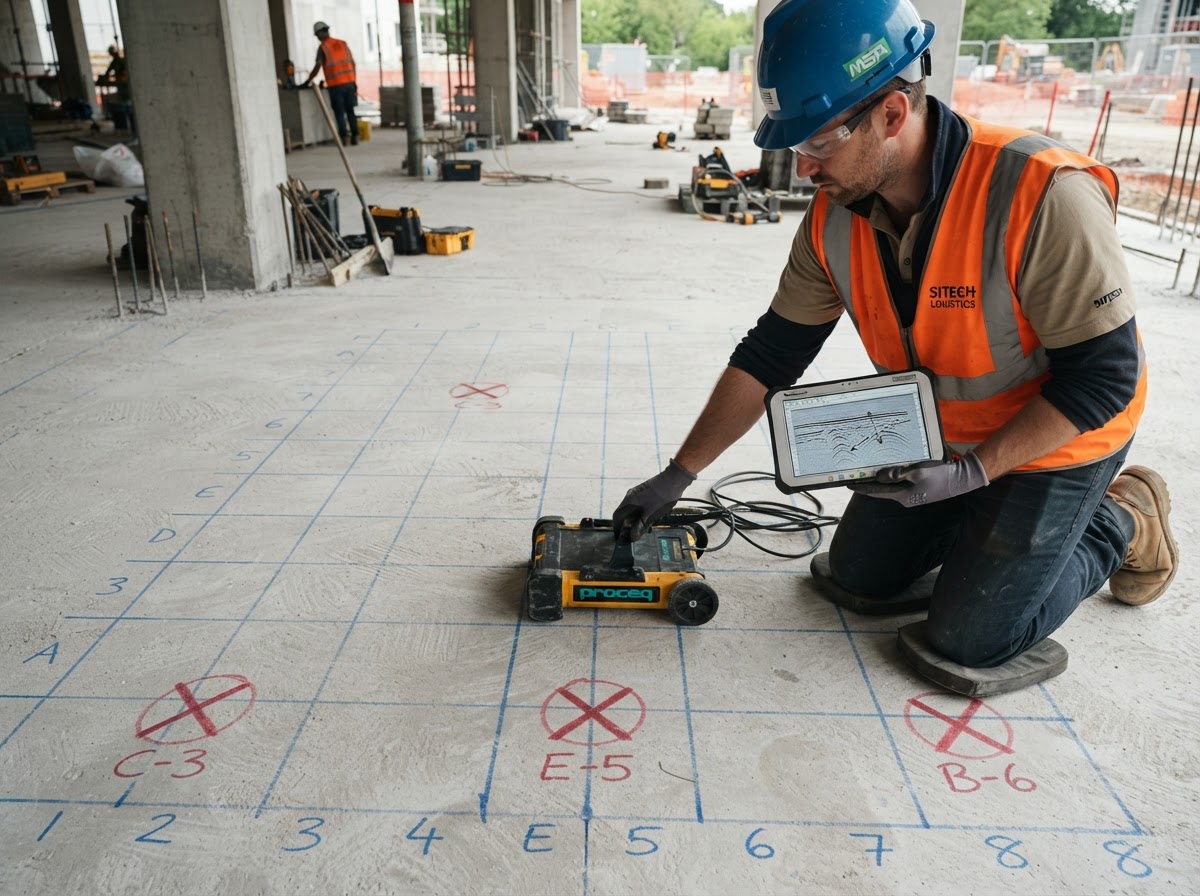
Scanning adds evidence before intrusive work
Ground-penetrating radar and other locating methods can help interpret the position and depth of reinforcing, post-tensioning and some embedded services within concrete. The surface is commonly marked so the proposed hole or cut can be reviewed against the interpreted targets.
Scanning is most useful when the question is specific: where can a penetration be considered, what obstructions appear near a cut line, or where should further investigation be focused?
- Map likely reinforcing patterns
- Identify responses consistent with post-tensioning or embedded services
- Review a proposed drilling or cutting zone
- Support set-out changes before intrusive work
- Create marked-up information or a report when included in scope
A scan is an interpretation, not an all-clear certificate
Results depend on concrete thickness, target depth, reinforcement congestion, moisture, surface condition, access, calibration and the operator's interpretation. Different materials can produce similar responses, and objects may be masked by shallower reinforcement.
Use the scan with drawings, utility information, service isolation, visual inspection and structural advice. If uncertainty remains, the responsible party should decide whether another method or location is required.
- Agree the target and required confidence before scanning
- Provide available drawings and known service information
- Record inaccessible or inconclusive areas
- Do not treat a blank-looking response as proof that the full depth is clear
- Keep an approval hold point between scanning and cutting
Prepare the surface and set-out
The scanner needs direct, safe access to the concrete surface. Floor coverings, wall linings, thick coatings, standing water, obstructions or limited grid space can reduce access or affect the survey plan.
Mark the proposed hole or cut before scanning where possible. Confirm which face is being scanned, the likely slab or wall depth, the service type of concern and whether results need to be marked, photographed or reported.
- Clear and accessible scan surface
- Proposed centres, lines or scan zone
- Known slab or wall build-up
- Expected reinforcement or service type
- Required marking, images and written deliverable
Keep a deliberate hold point before cutting
When scanning and cutting occur in the same attendance, the approved position should still be confirmed after the scan result is interpreted. Moving a hole to miss one target can introduce structural, clearance or service-design issues elsewhere.
The relevant designer, builder, trade or asset owner remains responsible for accepting the location. The cutting provider should work to that approved set-out and agreed tolerance.
What affects a scanning quote
| Job or scenario | What affects cost | What the quote should clarify |
|---|---|---|
| Small marked scan area before one hole or cut | Area size, depth, surface access, concrete condition, expected targets and reporting level | Set-up, marking, interpretation, report format, travel and whether follow-up scanning is included |
| Multiple penetrations or a larger grid | Number of locations, grid density, repeated set-out, congestion and access sequence | Area limits, marking convention, per-location assumptions, report and change control |
| Post-tensioned or heavily reinforced slab | Target congestion, depth, available drawings, scanner capability and interpretation limits | Specialist competence, scan method, engineering interface, exclusion zones and unresolved areas |
| Scan in an occupied or operational area | Access windows, floor finishes, furniture or plant, pedestrian separation and noise constraints | Site induction, staging, after-hours conditions, protection and deliverables |
| Combined scan and cutting attendance | Coordination between interpretation, approved position and cutting crew | Separate responsibilities, hold point before cutting, inclusions if a position changes and record handover |
Scanning cost depends on area, number of locations, congestion, access and the deliverable. It should not be treated as a guarantee that every embedded object will be identified.
Concrete scanning questions
Can scanning identify every cable or pipe?
No method should be presented as identifying every embedded object in all conditions. Results need qualified interpretation and should be combined with drawings, known service information and isolation.
Is scanning the same as locating underground utilities?
Not necessarily. Scanning within concrete and locating buried services can use different equipment, procedures and information. State exactly what material and area need to be investigated.
Will I receive a report?
Only if the agreed scope includes one. Confirm whether the deliverable is surface marking, images, a written report or a combination.
Can cutting start immediately after a scan?
Only after the result is reviewed and the position is approved by the responsible party. Uncertainty or a moved location may require further checking.