Services
Concrete Cutting Services for Penrith Jobs
Choose a method by the opening, orientation, depth, access and finish the job requires.
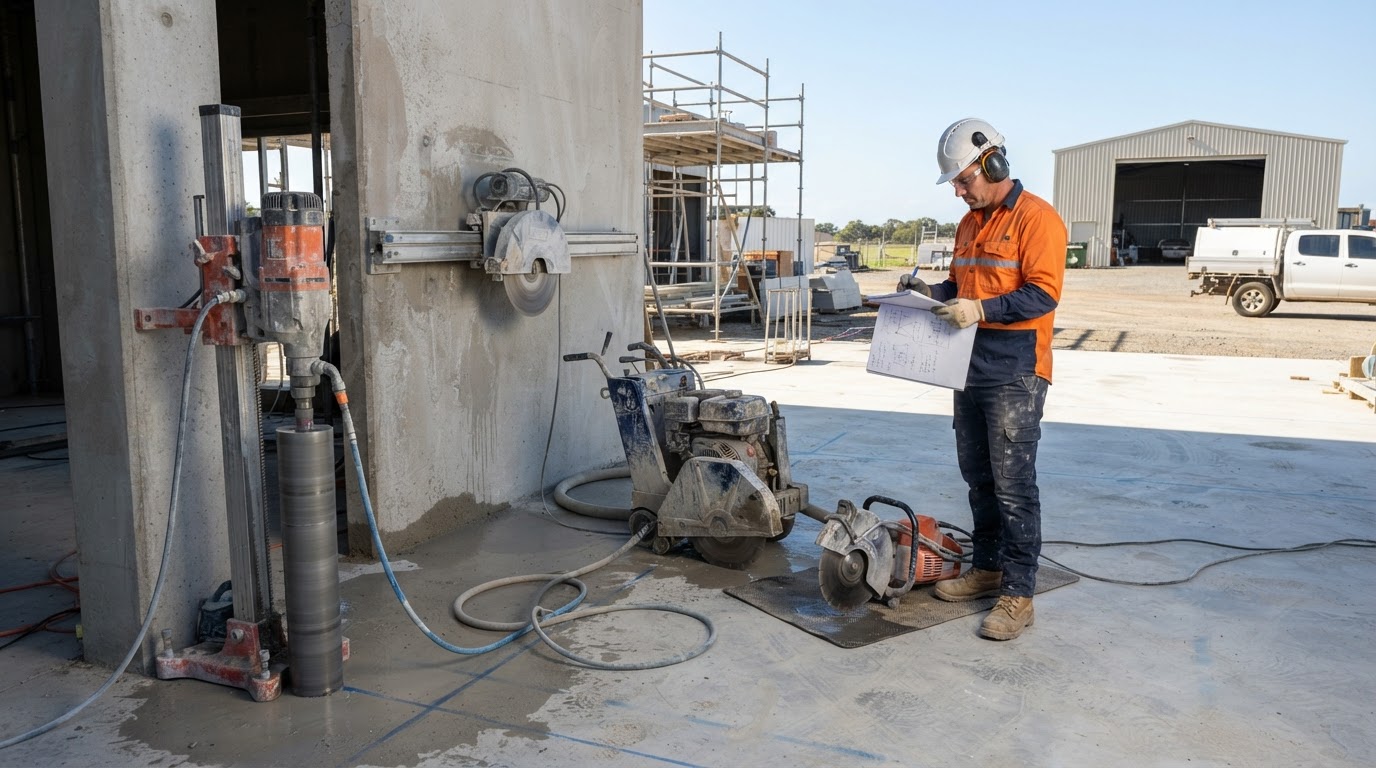
Match the method to the outcome
Concrete cutting is not one interchangeable task. A service penetration, doorway, trench, control joint and slab-removal package each place different demands on the equipment, work area and planning.
Begin with the shape and orientation of the cut. Then clarify depth, reinforcement, access, water or slurry controls, ventilation and what happens to the cut section.
- Core drilling — Circular penetrations for pipework, cable, ventilation and fixings.
- Wall sawing — Straight openings through vertical or inclined concrete.
- Road & floor sawing — Horizontal cuts in slabs, pavements, driveways and road surfaces.
- Hand & ring sawing — Detailed cutting where access, depth or edge position calls for portable equipment.
- Wire sawing — Large, deep or awkward sections that need a flexible diamond-wire system.
- Concrete scanning — Interpretation of reinforcement and embedded services before intrusive work.
- Soff cutting — Early-entry control joints in newly placed concrete.
- Concrete cutting & removal — Planned cuts combined with segment handling or disposal.
Circular openings
Circular openings and service penetrations
Core drilling is the usual starting point for a round hole through concrete or masonry. It may suit plumbing, electrical, communications, ventilation, anchors and sample cores.
The diameter alone is not enough. The provider needs to know depth, orientation, access, reinforcement, likely services, water control and whether the core can be safely retained or removed.
Straight & deep cuts
Straight cuts, restricted access and deep sections
Track-mounted wall saws create controlled linear openings. Floor saws travel across horizontal slabs. Hand and ring saws help with edge work or locations where larger equipment cannot be positioned. Wire sawing is reserved for sections whose size, depth or geometry makes conventional blades impractical.
These methods can overlap. The final choice follows the structural requirements, cut depth, available mounting or travel space, power and water arrangements, and how the segment will be supported.
Planning services before the blade starts
Concrete scanning may help interpret reinforcing and embedded services, but it is not a blanket guarantee that every object will be identified. It should be considered with drawings, service information, structural advice and the limitations of the site.
Soff cutting belongs to a different stage of construction: it is early-entry sawing for control joints in a newly placed slab. Timing and depth are coordinated with the concrete placement rather than treated as a later alteration.
When the section must come out
Some jobs end when the cut is complete. Others require the section to be supported, divided into manageable pieces, lifted, broken down, carried through restricted access or transported for disposal.
Cutting and removal therefore needs a handling plan as well as a cutting method. Weight, support, lifting access, finished surfaces and disposal conditions should be clarified before the provider prices the work.